Turning legacy refrigerants into measurable climate impact
Learn how a global network provider made a signficant climate impact by working with Tradewater to recover and destroy a potent legacy refrigerant, R-22.
Inside the case study
The action taken to eliminate R-22 had an immediate, measurable, and permanent climate impact.
Sign up to receive our case study and learn how this partnership:
- Prevented the release of high-impact greenhouse gases
- Supported responsible refrigerant lifecycle management
- Delivered measurable climate impact without disrupting day-to-day operations
Legacy refrigerants are a hidden climate risk
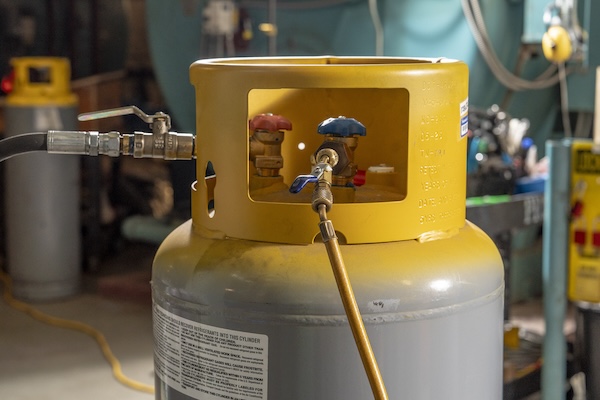
In 1987, the Montreal Protocol banned the production of these legacy gases, but left billions of tons unaddressed and without funding for safe disposal. As a result, these refrigerants are often reused in aging, leaky equipment, stored in deteriorating cylinders, or intentionally vented into the atmosphere, continuing to threaten both the climate and the ozone layer.
R-22 is classified as a hydrochlorofluorocarbon (HCFC) and is primarily used as refrigerants in air conditioning and refrigeration. Legacy gases like these are ozone-depleting substances (ODS) that break down Earth’s protective ozone layer while also acting as potent greenhouse gases that contribute to global warming.
R-22 has a GWP 1,810 times greater than carbon dioxide (CO2). Even relatively small leaks can have an outsized environmental impact.
A proven approach to eliminating superpollutants
Tradewater specializes in the destruction of high global warming potential (GWP) and ozone depleting substances, specifically legacy refrigerant gases. To date, Tradewater has permanently prevented the equivalent of more than 11 million tons of CO2.
In projects like this one, the carbon offsets generated from the destruction of refrigerants are available to purchase back for use in net-zero commitments. This gives a partnering company access to a source of high-quality carbon offsets that are generated from material inside the company’s own value chain with strong fidelity to their own carbon footprint. In turn, Tradewater uses money generated from selling these credits to reinvest in future superpollutant projects.
What this means for your organization?
Managing legacy refrigerants, such as older HCFCs like R-22, provides companies an opportunity to make a signficant impact in the near-term. By proactively recovering and eliminating these refrigerants, companies can reduce financial and operational risks, make meaningful progress toward ESG and climate goals, and achieve immediate, measurable impact.
Learn more about Tradewater’s refrigerant management services.